Small Talk Optional: How Quiet Hobbyists Build Real Friendships Without the Awkward Icebreakers
Every hobby community article eventually lands on the same advice: just show up! Walk into the meetup, smile, and introduce yourself. For roughly a third of the population, that sentence is about as helpful as 'just be taller.'
Here's the thing nobody says out loud: introverts aren't allergic to community. We're allergic to the on-ramp. The fluorescent-lit room full of strangers, the name tags, the 'so, what do you do?' loop repeated twelve times in one evening. That part is exhausting. But the actual friendship — the part where you're deep in a conversation about grain direction with someone who gets it — that part is why we're here at all.
The good news: the US hobby scene has quietly evolved a whole menu of low-voltage entry points. You just have to know where to look.
Start Where Talking Is Optional
The single best-kept secret in introvert-friendly community building is the parallel play session. Think of it as body doubling with better vibes. A group of people gathers — in a library meeting room, a coffee shop, someone's garage — and everyone works on their own project. Together. In silence. Or near-silence.
No introductions required. No obligation to explain your half-finished quilt to anyone. But here's what happens over three or four sessions: someone notices your project, you notice theirs, and a real conversation starts organically. These are the friendships that stick, because they're built on shared doing, not shared performing.
Look for 'craft and chat (chat optional)' events, silent book clubs (a genuinely exploding format — check if your city has a chapter of a silent reading group), or knitting nights at your local yarn shop where the needles do the talking. Many independent bookstores now host parallel-work writing hours. If your city doesn't have one, a library community room and a simple post in a local subreddit will get one started in under a month.
Let the Internet Do the Small Talk First
There's a reason Discord servers have become the default clubhouse for hobbyists. They let you calibrate your involvement to the exact wattage you can handle that day.
The introvert's playbook looks like this:
- Lurk with pride. Join the server, read the channels, learn the inside jokes. Nobody knows you're there. This is reconnaissance, not cowardice.
- Contribute artifacts, not conversation. Post a photo of your finished project. Answer one specific technical question you actually know the answer to. Artifact-posting gives people something to respond to without forcing you into real-time banter.
- Slide into the niche channel. Every good hobby server has a side channel — the #sourdough-fails, the #warped-boards thread. Small rooms, low stakes.
- Then, maybe, meet in person — with people you've already broken the ice with asynchronously.
By the time you walk into an in-person event, you're not meeting strangers. You're meeting people whose sourdough failures you've already witnessed. That's not small talk. That's a reunion.
Project Swaps: Friendship With a Deadline
Another format quietly gaining ground: the structured swap or exchange. Secret-scraper exchanges in the ceramics world, pattern swaps among knitters, seed exchanges among gardeners, 'make one, get one' trades among mini painters.
Why do these work so well for introverts? Because the structure does the social heavy lifting. You have a defined task, a deadline, and a reason to message one specific person ('hey, your package ships Friday, also I loved the glaze combo you posted'). It's connection with scaffolding. No wandering a room wondering who to talk to — the exchange already decided that for you.
Boundary Scripts for the Chatty Group
Sometimes the problem isn't finding community — it's surviving the one you joined. If your local group skews toward marathon talkers, arm yourself with a few polite exits:
- The time-box: "I've got a hard stop at 8, but I wanted to finish this row before I head out — it's been great chatting."
- The redirect to the work: "Okay, I need to actually focus now or this joint is never going to hold. Talk later?"
- The pre-announcement: Arrive having already told the organizer, "Just so you know, I usually duck out early — I'm better in small doses." Said once, it buys you a lifetime of guilt-free exits.
- The follow-up move: "I'm not much of a talker at these things, but I'd love to grab coffee sometime." Introverts often forget this is an option: one deep friendship beats a room full of acquaintances, and you're allowed to skip the room entirely.
A Field Guide to Introvert-Friendly Formats
If you're hunting for your fit, here are the formats with the best signal-to-noise ratio:
- Silent book clubs — read whatever you want, in public, together. Brief optional check-ins at the end.
- Parallel crafting/co-working sessions — shared space, individual projects, ambient companionship.
- Skill-swaps with structure — one person teaches, others learn, then rotate. Built-in agenda, zero mingling.
- Build-along workshops — everyone leaves with the same finished thing. Conversation happens naturally around the workbench.
- Async community challenges — monthly photo prompts, progress threads, and check-ins that live entirely online.
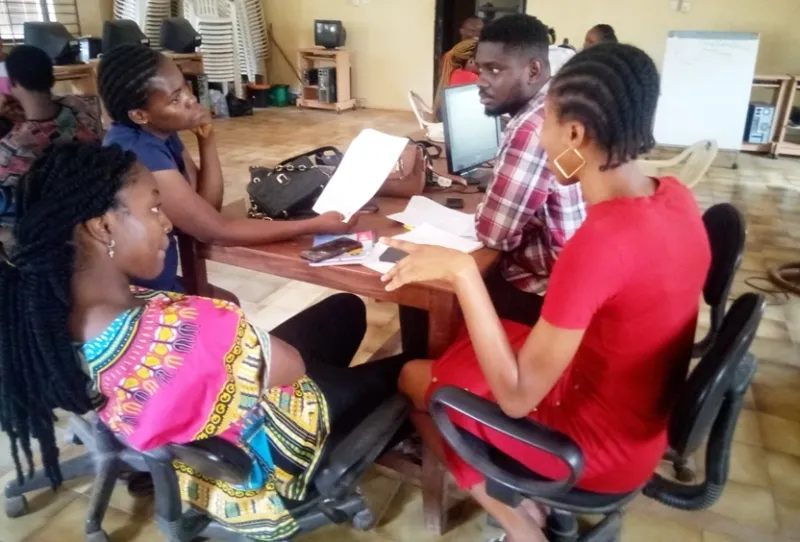
- Small-format meetups — the four-person table beats the forty-person mixer, every time. If your group's events feel too big, be the one who organizes the smaller offshoot.
You're Not Doing Community Wrong
The loudest voices in any hobby group will insist that real community means showing up to everything, every time, fully caffeinated and ready to mingle. Ignore them. Some of the strongest bonds in any club are between the two quiet people in the corner who've been helping each other fix mistakes for three years.
Community isn't a performance. It's a presence. Show up in the way that lets you stay — because staying, in whatever form you can sustain, is the whole game.